





A Game-Changing Victory
Crowning 22-year-old Lucas Jumalon as the 2026 WSOP Main Event Champion wasn’t just a run of good variance. It was definitive proof of a structural shift in world poker.
Taking down the $10,000,000 top prize and the most coveted bracelet on earth—after battling through a massive field and defeating Finland’s Lauri Saaskilahti heads-up—confirmed what the circuit was already sensing: the poker learning curve has changed forever.
Back in the day, reaching technical maturity required a decade on the live circuit, thousands of hours at the felt, and years of slowly absorbing table “feel.”
Today, the new generation reaches age 21 or 22 with more study volume and simulation work under its belt than many old-school pros accumulated over their entire careers.
From Solvers to the Felt: Compressing the Study Curve
How does a 22-year-old develop the composure to make $10 million decisions under the TV lights without flinching?
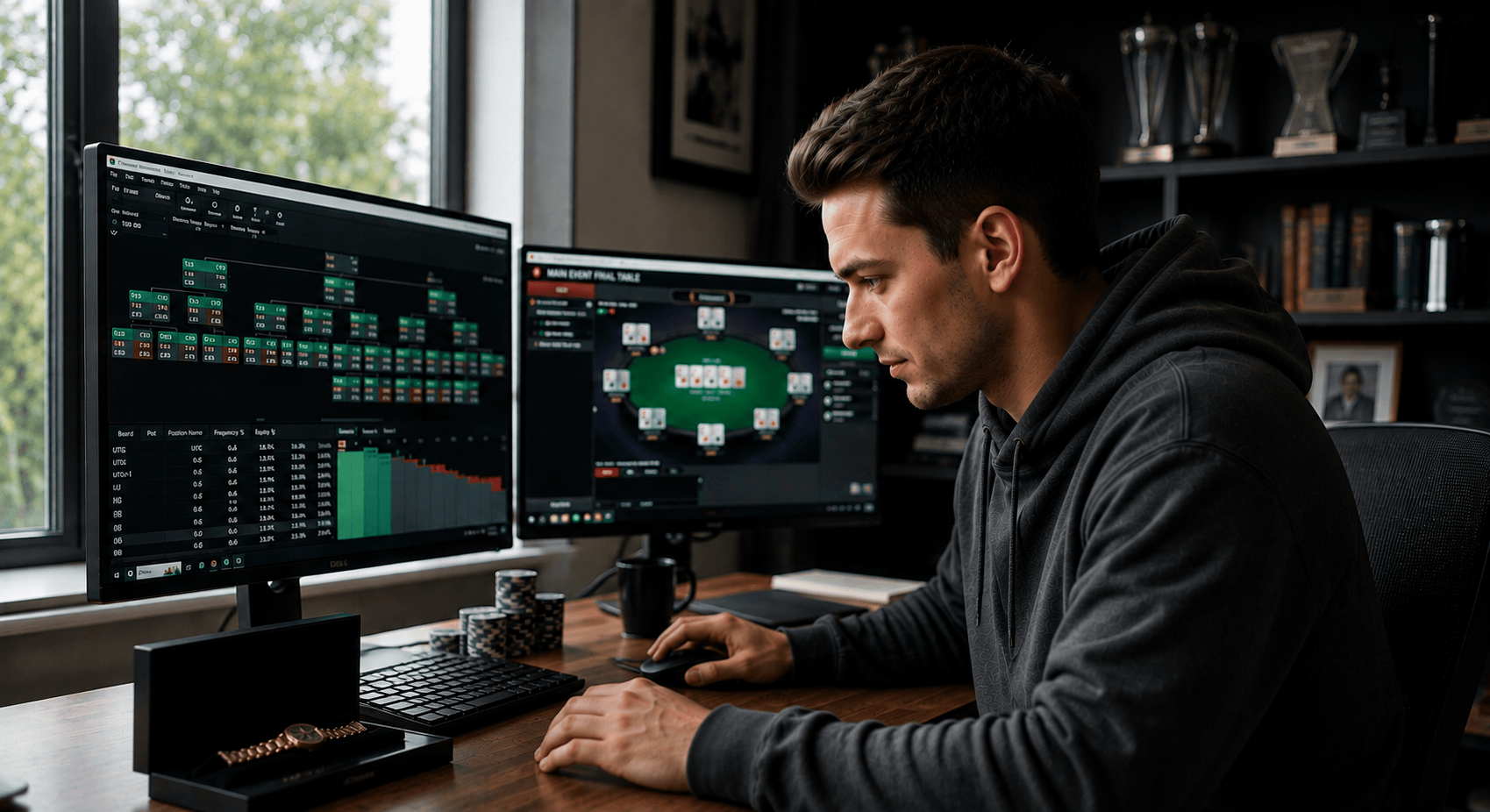
The answer lies in how the new wave of grinders leverages technology. Jumalon’s generation didn’t learn poker by watching rerun broadcasts from the 2000s. They learned through AI-driven training modules, node-locking, and advanced solver simulations.
Accelerated Study Volume
In just two or three years of daily solver work, a player can analyze more GTO scenarios than an old-school professional encountered during 15 years of live grinding.
Decision-Tree Mastery
Intuition has been reinforced by precise frequencies. When facing a difficult spot on a complex river, these young professionals aren’t simply guessing—they’re applying bluffing and value-betting frequencies they have drilled thousands of times.
Transitioning to Live: Beyond Pure GTO
The real difference between a “computer scientist” and a Main Event champion is the ability to translate theoretical knowledge to a physical table.
Jumalon proved that this new generation isn’t robotic. Its strongest players are fearless, observant, and highly adaptable.
The true edge in modern live poker comes from using GTO as a neutral baseline. The moment these young grinders identify an opponent’s leak, they pull the trigger on aggressive exploitative plays—without the mental block that scared money often creates.
3 Takeaways for Your 2026 Grind
Whether you’re grinding mid-stakes online or preparing for your next live tournament stop, Jumalon’s run offers three clear lessons for leveling up your game.
1. Build an Unshakable Theoretical Foundation
Before attempting elaborate hero plays, master your preflop opening ranges, bet sizes, and defense frequencies. Your off-table study needs to be disciplined, consistent, and structured.
2. Eliminate the Fear of Variance
The new generation succeeds because its best players don’t play scared money. If a decision is mathematically profitable, you make the play—whether it’s for a $10 pot or at the WSOP Main Event Final Table.
3. Adapt to the Table Dynamics
Stop playing on autopilot. Use your theoretical knowledge to identify exactly where your opponents are making mistakes—such as overfolding the turn or overcalling the river—and adjust your frequencies to punish those leaks.
Ready to Level Up Your Game?
The BeatDaGame team stays ahead of the curve to help you find the best poker rooms and rakeback deals for your stakes, playing style, and volume.