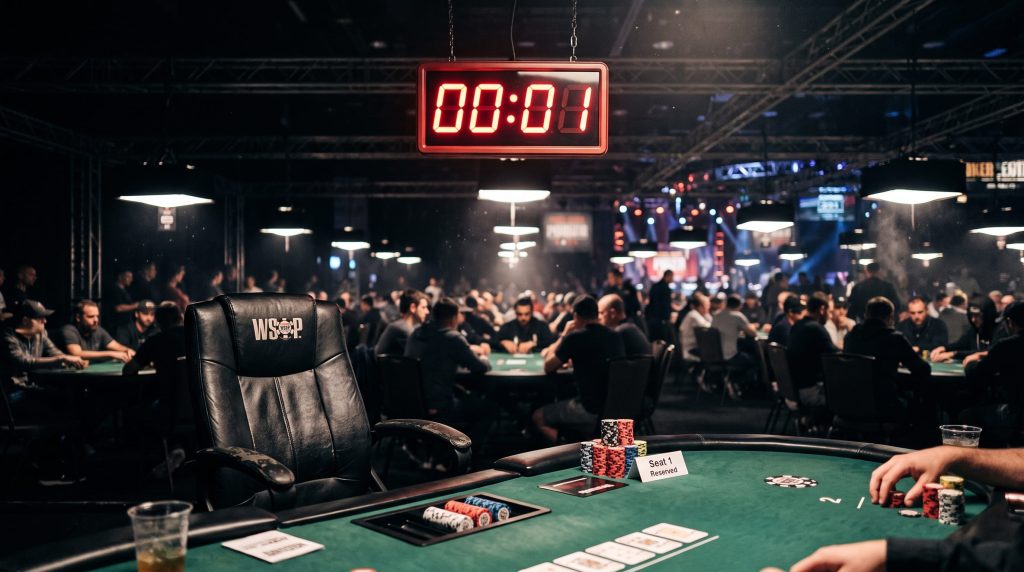






Scroll through the lobby of any major online tournament series 15 minutes before registration closes, and you will spot a familiar sight: high-stakes crushers entering with 12 to 15 big blinds.
To casual spectators, entering an event with a tiny stack right as the blinds are soaring looks like a reckless gamble. To game theory regulars, it is a calculated application of the Independent Chip Model (ICM).
Yet, max late-registering is not a universal cheat code. It presents a fundamental paradox: jumping into a tournament at the final second increases your immediate financial equity, but drastically reduces your ability to leverage post-flop skill.
Understanding where those two lines intersect is the difference between a high-efficiency schedule and burning buy-ins on pure variance.
The Mathematical Foundation: Instant ICM Equity
The primary reason professional grinders late-register non-bounty tournaments boils down to a core rule of tournament math: chips won are worth less than chips lost, and being absent from early bust-outs is profitable.
Imagine a 1,000-player freezeout where 150 spots pay out.
- By Level 10, 450 players have already busted without collecting a penny.
- The original prize pool remains intact.
- If you buy in at Level 10, you are entering a field of 551 players competing for the exact same total prize money that 1,000 players funded.
Because you skipped the fatal bust-out phase that eliminated 45% of the field, your starting stack is mathematically worth more than its nominal face value in real dollars ($EV) the second you hit the felt. Solvers confirm that in standard freezeouts with flat payout distributions, max late-registering provides an immediate 10% to 25% boost in cash equity relative to your buy-in.
The Hidden Cost: Sacrificing Edge and Realizing Equity
If late registration gives you free equity, why doesn’t everyone max late-reg every tournament? Because starting shallow carries heavy trade-offs:
Total Tournament EV = Base ICM Entry Equity + Realized Skill Edge Over Time
[Level 1 Entry: 200 BBs Deep] ───► High Post-Flop Edge | Maximum Playability | Lower ICM Value
[Max Late Reg: 15 BBs Shallow] ──► Zero Post-Flop Edge | Push/Fold Variance | Maximum ICM Valu
1. Loss of Deep-Stack Post-Flop Playability
When you sit down with 150 to 200 big blinds in the opening levels, you have room to exploit weak players through three-street bluffs, pot manipulation, and implied odds with speculative hands (suited connectors, pocket pairs). With a 15-blind stack, your strategy is stripped down to unexploitable push/fold charts and three-bet jams.
2. High Table Friction
By the time late registration closes, deep-stacked table leaders wield massive leverage. If you land on a table sandwiched between two aggressive 80-blind regulars, your 12-blind stack has virtually zero fold equity when pushing over opening ranges.
3. Escalating Variance
Playing short-stack poker turns your tournament life into a sequence of pre-flop coin flips. While your hourly rate ($/hour) might increase because you spend less time per tournament, your bankroll will experience sharper, more aggressive downswings.
Format Breakdown: Where Late Reg Works (and Where It Fails)
The profitability of entering late depends entirely on the game format and payout curve:
Tournament Format | Late Reg Viability | Strategic Assessment |
Standard Freezeouts | Optimal | Superb. No bounty distortion; max ICM equity gained from eliminated players. |
Satellites (Target Seats) | High +EV | The ultimate late-reg format. All prizes are identical; survival value completely outweighs chip accumulation. |
Mystery Bounty Events | Moderate / High | Profitable if late registration closes before the bounty phase unlocks on Day 2. |
Progressive Knockouts (PKOs) | Severely -EV | Terrible. Late entrants miss out on accumulated bounties and cannot cover bounty-heavy opponents. |
The Progressive Knockout (PKO) Trap
In a standard PKO, half of every buy-in goes into the bounty pool. As players get eliminated in the early levels, those bounty rewards are collected and distributed.
When you max late-reg a PKO with 15 big blinds:
- You pay full price for the bounty portion of the buy-in.
- Half the bounties in the room have already been cashed out by other players.
- Your shallow stack prevents you from covering other players to claim their bounties.
Late-registering deep into a PKO is mathematically equivalent to volunteering for a massive indirect tax on your buy-in.
The Practical Playbook: Finding the Sweet Spot
To strike the ideal balance between raw skill edge and ICM equity, apply these three scheduling benchmarks:
- The 35–45 BB Window for Standard MTTs: For typical multi-table tournaments, entering when the starting stack equals 35 to 45 big blinds is the strategic sweet spot. You bypass slow, ante-free early levels while retaining enough depth for three-betting, floating, and navigating turns.
- Push/Fold Discipline Under 20 BBs: If you do choose to max late-reg (12 to 20 BBs), abandon speculative calls immediately. Your entire edge relies on precise shoving ranges, reshoving over late-position steals, and ruthlessly exploiting tight bubble dynamics.
- Always Register On Time for PKOs: In bounty formats, sit down during Level 1. You need every chip possible to maintain coverage over recreational players who punt away their bounties early.
Late registration is a precision tool, not a lifestyle habit. Use it when the payout math supports your stack, and take your seat early when chip accumulation dictates the game.